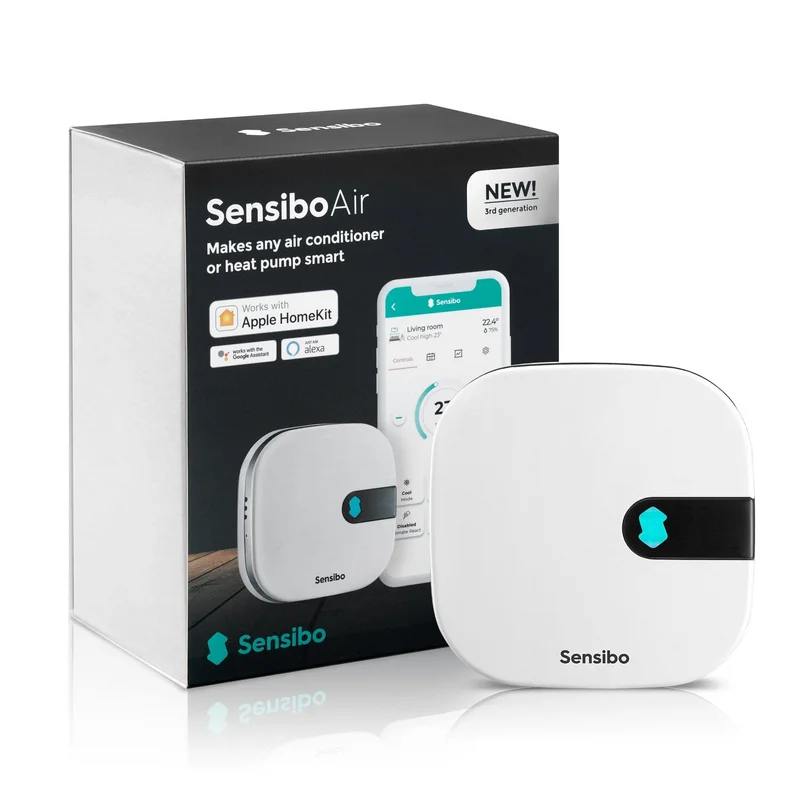
Sensibo Air Smart AC Controller
Sensibo Air is a small Wi-Fi and infrared box that sits by an air conditioner and hands it scheduling, geofencing, voice commands, and usage history through an app. Before pointing anyone toward it, we dug into who actually makes it and what outside testers found — rather than taking the spec sheet at face value.
What it actually does
Sensibo Air doesn't lower the temperature in a room by itself — it's a retrofit brain for an AC unit you already own. Plug it in near a mini-split, a window unit, or a central-air remote receiver, and it adds app-based scheduling, geofencing (so cooling can switch on ahead of your arrival and off after you leave), voice-assistant hookups, and a running log of how the system is used. If there's no existing air conditioner with a working infrared remote behind it, there's nothing for Sensibo to operate.
Who's actually behind it
Rather than take a product page's word for it, we traced the company itself. Sensibo was started in Tel Aviv in November 2013 by Omer Enbar and Ran Roth, and it currently runs offices in both Tel Aviv and Redwood City, California. That's more than a decade of continuous operation — a very different profile from a storefront that surfaces for one sales cycle and vanishes. Coverage of the device turns up in outlets that do hands-on testing rather than pay-for-placement roundups: the Australian consumer group CHOICE, the smart-home outlet TechHive, and The Ambient have all put it through independent review.
A red flag worth flagging
One thing we ran into and want readers to know about: a number of aggregator sites pass around an "8.2/10 expert consensus" score for this device. We tried to trace that figure back to CHOICE, TechHive, The Ambient, or any other tester we could identify, and came up empty. That doesn't necessarily make the number wrong, but an unsourced score that can't be attributed to a named reviewer isn't evidence — treat it as noise rather than as part of the actual case for buying.
Good fit versus not a fit
This makes sense if you already own an air conditioner, mini-split, or window unit with a functioning infrared remote and you'd like to layer scheduling, geofencing, or voice control on top of it. It's the wrong purchase if you don't own any cooling hardware yet and are shopping for something that will actually chill a room — Sensibo adds smarts to an AC, it does not replace one. Compatibility is broad but not universal: infrared command sets differ by manufacturer and sometimes by product generation, so check the current compatibility list on the maker's own site before buying rather than assuming your specific model is covered.
For comparison, one competing controller, the Cielo Breez Plus, does have an on-device display, which is a genuine advantage over Sensibo's screen-free design. But when we tried to confirm the company behind that competitor, our research kept surfacing an unrelated Brazilian firm called Cielo S.A. instead, and we couldn't independently verify a clean corporate trail for the Breez Plus maker. Given a choice between a longer, traceable operating history and a display we'd rarely look at, we lean toward Sensibo.
Where we'd buy it
We link to authorized retailers and may earn a commission at no extra cost to you if you buy through the link below. The link opens a live Amazon search for this exact product rather than one listing we control directly, so double-check the seller and current price before you check out.
Common questions
Does Sensibo Air cool a room on its own?
No. It's a controller, not a cooling appliance, and it has to be paired with an air conditioner, mini-split, or window unit that's already installed.
Will it work with my specific AC unit?
Coverage is wide, but infrared command sets vary by brand and by generation, so confirm your exact model against the manufacturer's current compatibility list before ordering.
Is there an actual company behind this, or is it a shell brand?
It's a real, continuously operating business — founded in Tel Aviv in 2013, with offices there and in Redwood City, California, and more than a decade of history to check against.
Sources
Sensibo company history (company "About" page and public corporate records); CHOICE (Australia) independent testing; TechHive hands-on coverage; The Ambient smart-home coverage.